Running Agentic Frameworks Without Burning the Budget
Agentic systems get expensive when every loop becomes a premium reasoning event. Here is how BlackUnicorn AI Management System uses tiered routing, budgets, compression, prompt caching, and governance to keep cost control inside the runtime.

Agentic AI becomes expensive when every action is treated as a premium reasoning event.
A prototype can hide that problem. A few agents, a few tools, a few impressive traces. Then the system meets real operations: persistent memory, retries, approvals, background planning, safety checks, tool calls, long prompts, dashboards, budget ceilings, and human review.
Suddenly the cost is not "one model call." It is the accumulated tax of every static instruction, every repeated memory chunk, every unnecessary escalation, every cache miss, and every agent loop that should have stopped earlier.
We built BlackUnicorn AI Management System around a stricter question:
What does it take to run an agentic framework where cost control is part of the runtime?
BlackUnicorn AI Management System is not a prompt wrapper. It is a multi-agent operations platform with routing, memory, governance, compression, prompt caching, budgets, and decentralized computing built into the operating model.
The Core Idea: Tier the Work
BlackUnicorn AI Management System uses 3-layer LLM routing:
- L1 local Ollama for routine reasoning, memory work, internal analysis, confidential tasks, and DSP-high workloads.
- L2 subscription providers for stronger external reasoning without pay-per-token exposure.
- L3 pay-per-token models only when the task justifies the spend.
That gives the platform a simple rule: cheap by default, expensive by exception.
The system does not ask, "What is the strongest model available?"
It asks:
- What class of work is this?
- Where should it run?
- What is it allowed to know?
- How much is it allowed to cost?
Budget-Aware Routing
The routing system is not only tiered by model quality. It is tiered by budget state.
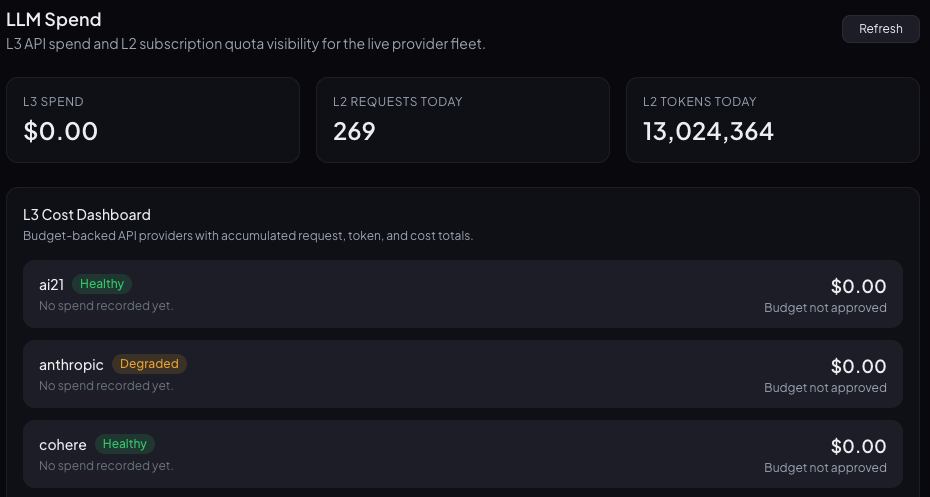
BlackUnicorn AI Management System lets operators set budget limits and route agents accordingly. Provider budgets, subscription quotas, extra-usage caps, and per-agent spend limits all become routing inputs.
When an L3 pay-per-token route has no approved budget, the router does not use it. When a provider quota is exhausted, that provider is skipped. When extra usage is disabled, the system does not silently cross into paid overage. The agent is routed through the remaining allowed paths, usually L1 or L2 depending on the policy. If no permitted route remains, the system fails closed.

That distinction matters.
A weak cost-control system warns after the bill arrives. A real one changes execution before the next expensive call.
BlackUnicorn AI Management System supports two budget layers:
- Provider-level budget gates: L3 routes require explicit budget approval, daily caps, monthly included amounts, and extra-usage settings.
- Per-agent budgets: agents can have daily token caps and daily USD caps, so spend is controlled at the worker level rather than only at the provider level.
This makes agent cost visible and enforceable. A research agent, coding agent, finance agent, and executive assistant do not need the same budget profile. The platform can treat them differently.
The result is not just spend reporting. It is budget-aware execution.
Decentralized Computing Changes the Economics
BlackUnicorn AI Management System runs across decentralized compute rather than assuming one cloud environment should do everything.
Local inference nodes handle L1 work. Enterprise hosts run core services. Memory and vector retrieval sit close to the agent runtime. Provider routes exist, but they are controlled routes, not the default posture.
This matters because agentic workloads are not uniform.
A memory extraction task does not need the same model as a strategic plan. A confidential goal should not leave the local network. A cheap classifier can run before an approval escalates. A long context can be compressed before it ever reaches a paid provider.
Decentralized computing lets the framework place work where it belongs: local when possible, subscription when useful, pay-per-token when justified and approved.
Memory Is a Cost Feature
BlackUnicorn AI Management System uses 3-tier memory:
- Tier 1: global memory for shared organizational context.
- Tier 2: agent-specific memory for role history and operating knowledge.
- Tier 3: session memory for short-lived task context.
Memory is usually described as intelligence. In production, it is also cost control.
Without structured memory, agents rediscover the same facts. They rebuild context. They ask for information they already had. Every repetition becomes tokens.
A good memory system keeps prompts smaller because the agent receives relevant context instead of dragging the entire past into every call.
Compression Is a Runtime Primitive
BlackUnicorn AI Management System has two compression layers.
The first is working-context compression. Retrieved memory chunks pass through classification stripping, DSP entity sanitization, and PII stripping first. Then the compressor deduplicates structurally identical chunks and truncates oversized chunks once the context crosses the token threshold.
For larger contexts, the system can run an L1-only generative pass: the chunk list collapses into one local-model summary, on-VLAN, without external egress.
The second is Caveman mode, the agent-prompt compression layer. Long SOUL/persona files are shortened into telegraphic operating instructions, while safety-critical regions are marked with COMPRESSION_EXEMPT blocks and preserved verbatim.
That distinction is the point. Compress filler. Preserve invariants.
Caveman mode covers 23 agents and is estimated at roughly 770K tokens/day saved. It is not a style trick. It is token infrastructure.
Prompt Caching Makes Static Tokens Cheap
Agent systems spend a lot of tokens on text that barely changes: role, identity, rules, onboarding, permissions, operating principles, and tool contracts.
BlackUnicorn AI Management System uses provider prompt caching so that static prefix does not get billed at full weight on every dispatch.
For OpenAI Codex-style dispatches, the system derives a stable session id from the agent's static content: SOUL.md, IDENTITY.md, and onboarding.md. When those files change, the hash rotates automatically. Same agent content means same cache key. New content means fresh cache key.
For direct provider paths, the system derives deterministic prompt_cache_key values from system prompt content. Kimi and OpenAI Codex paths both get stable cache keys for repeated system prefixes. Usage accounting tracks cache-read and cache-write tokens so the savings are visible.
The rule is simple: static instructions should be cached, dynamic context should be compressed, sensitive context should stay local.
Governance Reduces Waste
Governance is not only risk control. It is cost control.
BlackUnicorn AI Management System uses approval tiers:
- T1 auto-execute for low-risk work.
- T2 notify for visible but non-blocking decisions.
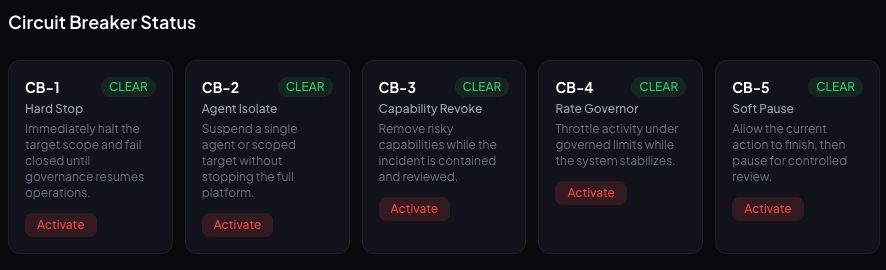
- T3 block-until-approved for sensitive, expensive, or high-risk actions.
This prevents agent loops from turning into silent spend. It also prevents casual escalation into L3 pay-per-token routes.
The same principle applies to the Data Sanitization Proxy (DSP). DSP-high work is pinned to L1. Confidential paths fail closed instead of falling through to an external provider because that would be convenient.
A serious agentic framework needs hard stops.
The Practical Pattern
The low-cost agentic stack is not one feature. It is a set of controls working together:
- 3-layer routing: L1 local -> L2 subscription -> L3 pay-per-token.
- Budget-aware routing: skip exhausted or unapproved paid paths and route through allowed alternatives.
- Per-agent budgets: daily token and USD caps at the agent level.
- Provider budget gates: no L3 pay-per-token usage without explicit approval.
- Decentralized compute: run workloads where they are cheapest and safest.
- 3-tier memory: retrieve relevant context instead of replaying history.
- Working-context compression: dedup, truncate, and summarize before dispatch.
- Caveman mode: compress static agent prompts without stripping safety invariants.
- Prompt caching: reuse static system-prefix tokens across dispatches.
- Approval tiers: stop expensive or sensitive actions before they run.
- DSP routing: keep classified and DSP-high work local by design.
This is how BlackUnicorn AI Management System keeps agentic operations economically sane.
Not by hoping model prices fall.
By treating tokens, routing, memory, budgets, compression, caching, and governance as runtime primitives.
What We Learned
The expensive part of agentic AI is not one model call. It is the repetition around the call: repeated instructions, repeated context, repeated escalation, repeated retries, repeated rediscovery, repeated use of paid routes when a cheaper route would do the job.
BlackUnicorn AI Management System reduces that repetition at several layers.
Cache the static prefix. Compress the working context. Retrieve only the memory that matters. Run local by default. Route around exhausted budgets. Escalate with intent. Gate high-risk actions. Keep confidential work on local compute.
That is the operating model.
BlackUnicorn AI Management System is our answer to a practical engineering question: how do you run a real agent fleet without turning every thought into a premium cloud event?
This is a builder's journal. We are sharing the architecture because production agentic systems need fewer demos and better operating models.