Context Should Compound Inside Your Organization
Organizational memory is not a larger prompt history. It is governed context with ownership, access, provenance, retention, and a path out of the supplier account.

An organization can use AI every day and still learn nothing as an organization.
One person refines a useful instruction. Another resolves an exception. A third discovers that a source is unreliable. The next interaction begins without that knowledge, or the knowledge remains trapped in a personal chat history that the organization cannot govern.
Activity increases. Institutional capability does not.
Context compounds when useful knowledge becomes available to the right work, under the right access rule, with enough provenance to trust it. It stops compounding when it is scattered across individual accounts, copied into prompts, or retained inside a supplier system with no operating path back to the organization.
BAMS treats context as governed infrastructure.
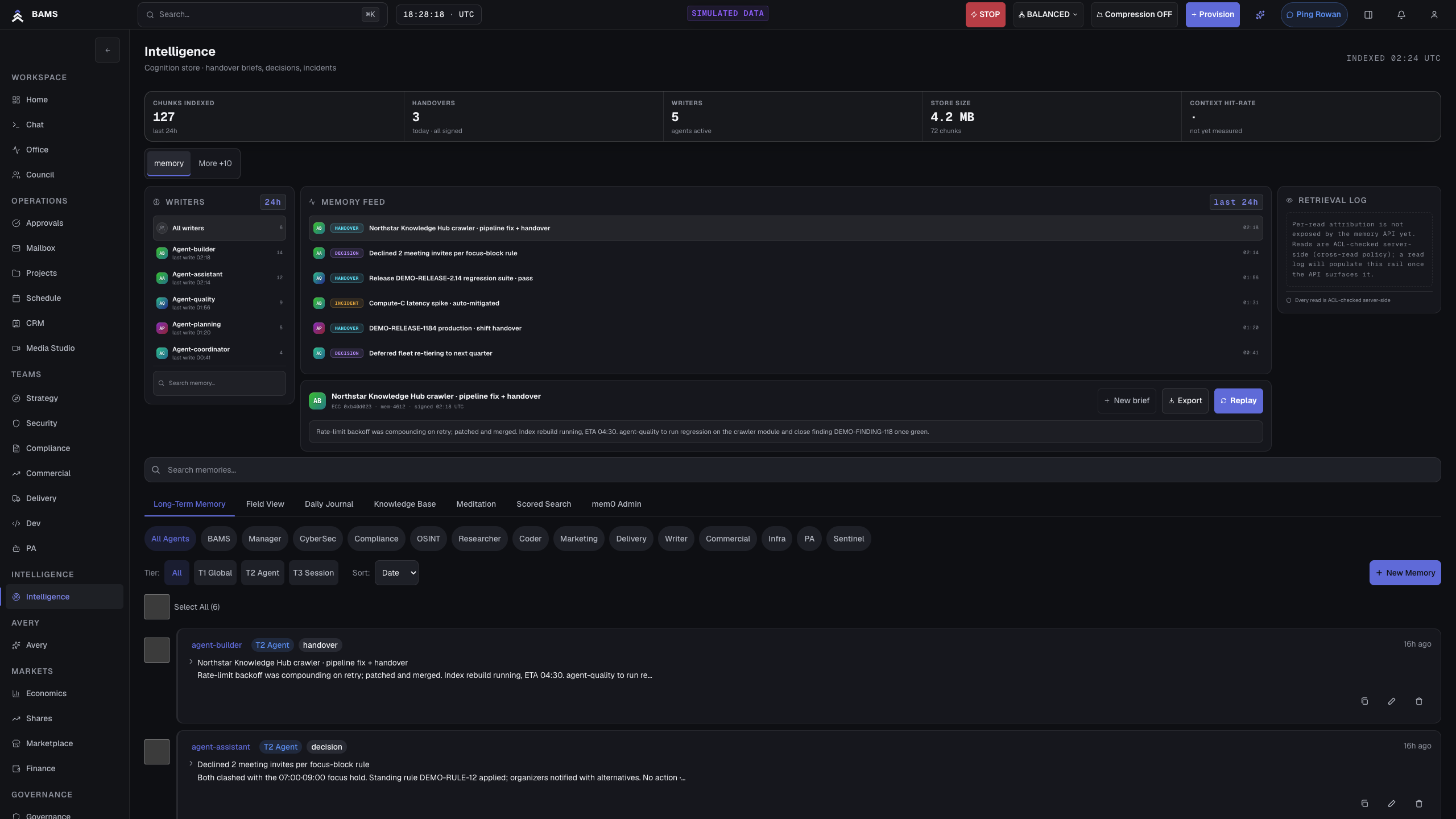
BAMS organizational memory interface. All displayed data is simulated.
Prompt History Is Not Organizational Memory
A conversation history can make one session more convenient. It does not automatically create an organizational asset.
Organizational memory needs answers to questions that a chat history rarely addresses:
- Who created this memory?
- Which source supports it?
- Which project or function owns it?
- Who may retrieve it?
- Does it contain personal, confidential, or classified information?
- When should it expire or be reviewed?
- What supersedes it?
- Can it be exported in a usable form?
- Can the organization reproduce the retrieval policy outside the supplier account?
Without these properties, a memory feature can create a second knowledge problem. It accumulates context without a reliable way to govern, correct, or retire it.
The problem grows as agents act on the retrieved material. A stale note is no longer a minor search result. It becomes input to a recommendation, a tool call, or a decision.
Relevance and Permission Are Different Tests
Retrieval systems are commonly evaluated on relevance. Did the search return text related to the question?
Enterprise retrieval has a second test: was this identity allowed to receive that text for this work?
A finance forecast may be relevant to a commercial planning task and still be restricted. A security incident may help an engineering agent explain an outage and still contain information that the agent cannot use. Two teams may use the same term while operating under different access boundaries.
The retrieval layer must keep these distinctions intact.
In the BAMS reference implementation, memory is connected to database-backed access control and filtering for confidential and classified contexts. Memory search, long-term memory, writers, and access information appear as operator surfaces rather than an invisible prompt extension.
This gives the organization a place to inspect who contributes context and how that context enters work.
It also establishes a principle for client deployment: approved organizational sources must be connected under the client's access, classification, and retention rules.
The Five Properties of Governed Context
We use five properties to decide whether context can become organizational memory.
1. Ownership
Every memory domain needs an accountable owner. The owner decides which sources are authoritative, how conflicts are resolved, and when material should be retired.
An embedding does not remove the need for stewardship.
2. Access
Retrieval must respect the identity performing the work. The same query can produce different permitted results for two identities.
Access should be enforced at retrieval, not left to a prompt that asks the model to ignore restricted text.
3. Provenance
The system needs enough origin information to explain why a memory exists. That can include source, author or writer, collection, project, timestamp, and transformation history.
Provenance lets an operator challenge a result. It also makes correction possible.
4. Lifecycle
Context changes. Policies are replaced, projects close, people leave, and exceptions expire.
The memory layer needs retention, review, update, and deletion procedures. Permanent accumulation is not the same as learning.
5. Portability
The organization should be able to export the useful knowledge and the metadata required to interpret it. A pile of text without its access and provenance model is a partial export.
Portability also requires documentation of how context is written and retrieved. Data access alone does not transfer the operating capability.
Plugging Into Existing Knowledge
"Plug into your knowledge" is easy to say and dangerous to leave undefined.
A responsible deployment begins with a named set of sources and a narrow workflow. For each source, the team records:
- The system of record.
- The source owner.
- The classification and permitted identities.
- The retrieval or import method.
- The fields or documents included.
- The update and deletion behaviour.
- The evidence retained for each retrieval.
- The failure state when the source is unavailable.
Only then should the source enter the workflow.
BAMS supports memory search, seeding, and import in its current reference implementation. It also presents integrations as explicit operational components with health states.
We do not turn that into a claim that every organizational system is ready to connect. The tools and external integrations surface includes a mixture of configured, degraded, disabled, and deployment-specific adapters. A connector belongs in a client scope only after it is named, configured, secured, and tested.
That limitation protects the client from a common failure pattern: broad connector promises followed by an implementation that quietly exports more data than the workflow requires.
Context Should Improve the Operating System
Useful memory is not limited to source documents.
An operated workflow also produces knowledge:
- which exceptions recur
- which approval conditions cause delay
- which sources create conflicting answers
- which model route performs reliably for a bounded task
- which instructions reduce rework
- which agent permissions are broader than necessary
- which evidence an operator needs to resolve a dispute
This information should improve the workflow. It can inform a revised rule, a better source, a narrower permission, or a new acceptance test.
It should not be fed back into a model without review simply because it exists. An agent's output is not automatically a verified fact. A governed memory process distinguishes source material, human decisions, model output, and validated operating knowledge.
That distinction prevents the system from teaching itself its own errors.
The FDE Handover for Knowledge
The Forward Deployed Engineer has a specific responsibility in this layer.
The FDE maps the initial sources and access rules with the client's owners, implements the bounded retrieval path, documents memory writers and readers, tests denied access, and transfers the procedures for update, export, and retirement.
The handover should answer:
- Which sources are connected?
- Which sources were considered and rejected?
- Which identity can retrieve each class of context?
- Where is provenance stored?
- How does an owner correct a memory?
- How does the organization remove a source?
- What is exported during exit?
- Which parts require further productization?
The objective is to leave the organization with a governed knowledge capability, not a dependency on the person who configured retrieval.
Current Product Boundary
BAMS has a working memory stack and operator interfaces in its internal reference implementation. The deployment model is being shaped into a commercial beta appliance for client-controlled environments.
Customer-safe workspace isolation, repeatable connector hardening, and portable buyer evidence exports remain active product work. These boundaries matter when evaluating whether a given knowledge source is ready for a client deployment.
We can demonstrate how governed memory is represented and operated today. We will scope customer sources one by one. We will not claim universal connectivity or perfect isolation before the commercial beta acceptance tests prove them.
The Ownership Test
Ask five questions before allowing an AI supplier to become the place where organizational context accumulates:
- Can we see who wrote the context and where it came from?
- Can we enforce access before retrieval?
- Can our owners correct, expire, and delete it?
- Can we export the content with the metadata that makes it usable?
- Can our operators run the memory process without the supplier's engineer?
If the answer is no, the organization may be training its people to work through a knowledge layer it does not control.
Context should become an institutional asset.
That requires more than remembering a conversation. It requires ownership, access, provenance, lifecycle, portability, and an operating handover.
That is how knowledge compounds inside the organization instead of inside the supplier relationship.
A Memory Acceptance Test
The client should test organizational memory as a governed workflow rather than a search demonstration.
Use a small set of approved, denied, stale, corrected, and conflicting sources.
The test can verify:
- An authorized identity retrieves the expected context.
- A restricted identity cannot retrieve the same context.
- The result retains enough provenance to identify its source.
- A correction changes later retrieval in the expected way.
- An expired or deleted item no longer appears.
- Conflicting sources produce an explicit exception or ordering rule.
- A failed source enters a visible operational state.
- The agreed context and metadata can be exported.
The evaluation should distinguish retrieval failure from model failure. If the correct source never entered context, changing the model may not improve the result. If the source entered correctly and the response remains unacceptable, the model, instructions, or workflow may need attention.
This distinction helps teams fix the right layer.
Memory Writers Need Authority Too
Read access receives attention because it controls what an agent can see. Write access determines what future agents may believe.
A memory writer can introduce a reviewed fact, a temporary observation, a model-generated summary, or an unverified assumption. These items should not have the same status.
The memory process needs to record:
- writer identity
- source type
- verification state
- owning domain
- permitted readers
- retention or review date
- relationship to superseded material
BAMS exposes memory writers in its intelligence surface. The client deployment must decide which identities may write to which memory domain and whether human review is required.
An agent should not convert its own output into institutional truth merely because the output was useful once.
Migration and Exit
Memory portability needs to be designed before an export is required.
The exit inventory should include the stored content, source references, classifications, access relationships, ownership, timestamps, lifecycle state, and any transformation required to use the material elsewhere.
It should also identify what cannot be transferred because of licence, system, or format constraints.
The client operator should run a sample export and verify that an independent reviewer can interpret it. A file that only the supplier's importer understands is not a complete handover.
This is where the FDE and product responsibilities meet. The product needs an exportable representation. The engagement needs a scoped inventory, procedure, and acceptance result.
The outcome is not perfect portability between every memory technology. It is a known, usable exit path for the organizational context in scope.
Context Quality Is an Operating Responsibility
Governance does not make every memory correct.
It makes correction possible and accountable.
The knowledge owner still needs a process for disputed, stale, duplicated, or low-quality context. An operator should be able to see the source, mark the issue, prevent unsafe reuse where required, and route the correction to the right owner.
The workflow can also distinguish how context is used. A verified policy may support a deterministic rule. A human-approved exception may inform a recommendation. A model-generated summary may remain advisory until reviewed.
These states reduce the chance that useful text acquires more authority than its source supports.
BAMS provides a memory and access layer in which these distinctions can be represented. The commercial beta deployment needs to apply the client's quality and retention rules to the named sources in scope.
The FDE should leave the client with an operating queue for context issues, not a promise that retrieval will remain correct by itself.
Organizational memory improves when its owners can see uncertainty, correct it, and preserve the reason for the change.
<!-- Editorial evidence: E03 in series/bams-no-strings-attached/EVIDENCE-LEDGER.md -->