Own the Infrastructure. Control the Model Layer.
Enterprise control does not require owning every model weight. It requires authority over deployment, routing, policy, budget, provider choice, and the context each route may receive.

"Own your models" sounds precise until the architecture review begins.
Does ownership mean the organization trained the model? Holds the weights? Has a licence to run them? Controls the infrastructure? Selects the provider? Determines which data may be sent? Can disable the route? Can replace it without rebuilding the workflow?
These are different rights.
An enterprise AI strategy should not blur them into one slogan.
Our position for BAMS is more specific: own the infrastructure where the governed system runs, and control the model layer that serves each workload.
That does not imply ownership of a provider's intellectual property. It means the organization controls the decision about what runs, where it runs, which context it receives, what it costs, and what happens when it fails.
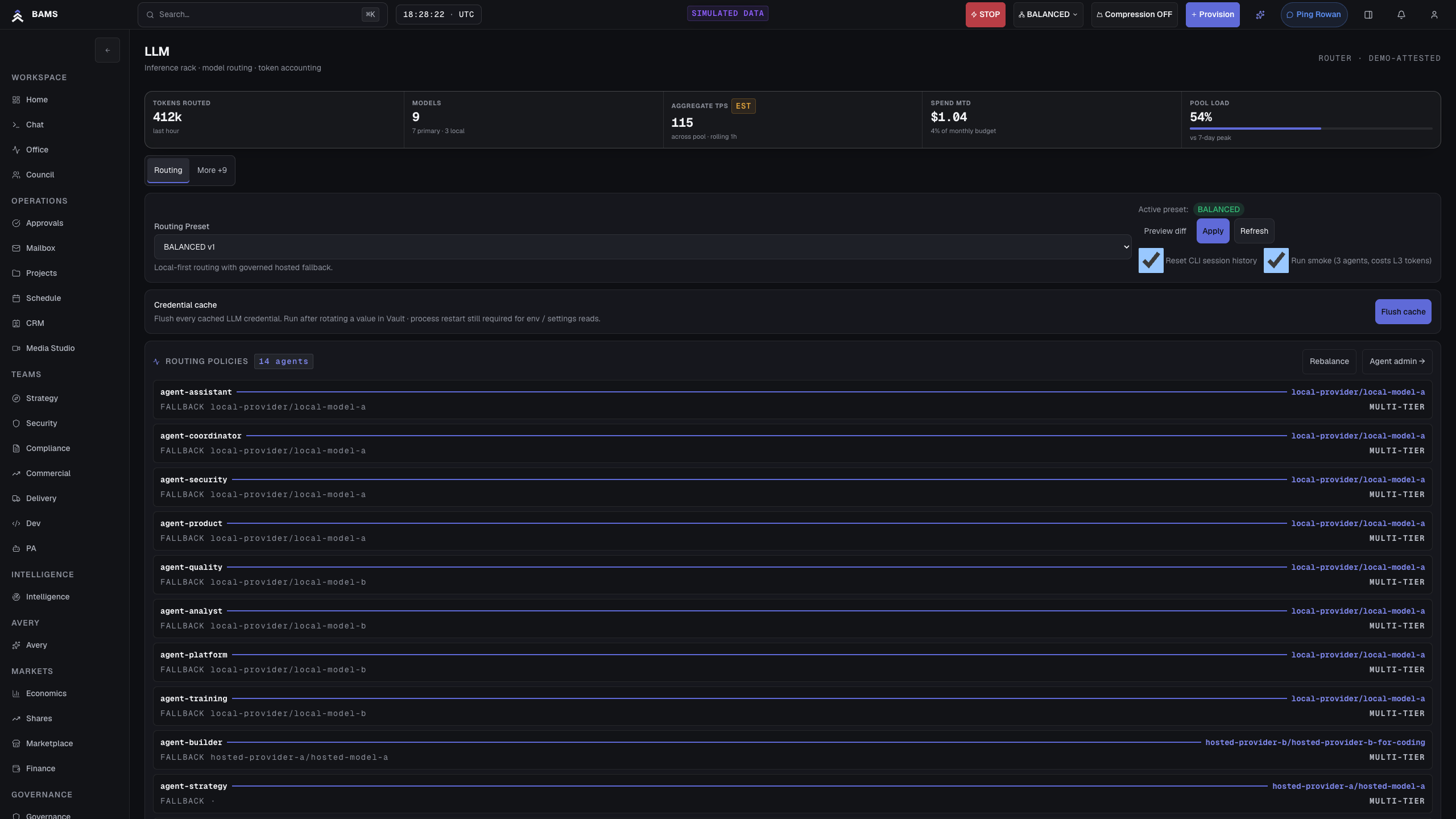
BAMS model routing and provider controls. All displayed data is simulated.
Four Different Ownership Questions
The model layer contains at least four ownership questions.
Infrastructure ownership
Who controls the environment where the application, memory, orchestration, storage, and local inference services run?
This affects network boundaries, operations, backup, recovery, observability, and exit.
Model rights
What legal and technical rights does the organization have for each model?
An open-weight model, a licensed model, and a hosted API have different terms. The organization may own none of their underlying intellectual property while still having a valid right to use them.
Routing control
Who decides which model receives each class of task?
Routing should account for data classification, task type, quality, latency, availability, policy, and cost. The rule should be inspectable and changeable by authorized operators.
Context control
What information may each route receive?
A provider choice is also a data-boundary choice. The system needs to know when a task must remain local, when a request can be sanitized, and when an external route is permitted.
These four questions produce a clearer design than asking whether a company "owns AI."
Treat Models as Governed Resources
An application that names one model endpoint in code has made a fixed technical choice.
An operated model layer represents providers and routes as resources with state.
Operators need to see:
- provider and model availability
- route bindings by workload or policy
- local and external inference options
- health and failure state
- quotas and budgets
- usage and spend
- fallback behaviour
- credentials and access path
- enable and disable controls
- the evidence of a route change
BAMS provides these concerns in its model administration surface. The current reference implementation includes provider configuration, route bindings, quota, budget, spend, health checks, enable and disable operations, and local inference support.
The database acts as the routing source of truth for those configured routes. That matters because operators can inspect and change a policy without searching application code for scattered model names.
The Route Is a Policy Decision
Consider three document tasks.
The first extracts public product specifications. The second summarizes an internal operating procedure. The third analyses a confidential finance record.
All three may benefit from a language model. They should not automatically use the same route.
A governed routing policy might require:
- Public material may use an approved hosted model.
- Internal material may use a hosted route only after required sanitization.
- Confidential finance material remains on an approved local inference path.
- A failed local route does not silently fall back to an external provider.
- A route change above a defined risk or cost threshold requires approval.
The exact policy belongs to the organization. BAMS provides an operating layer in which the choice can be represented and controlled.
That distinction is important. We are not asking a buyer to adopt BlackUnicorn's universal answer to model selection. We are giving the buyer a way to apply its own answer consistently.
Local Models Are a Control, Not a Religion
Local inference can reduce exposure, improve control over availability, and support workloads that cannot leave an environment. It can also introduce capacity, latency, update, evaluation, and operational responsibilities.
Hosted models can provide useful capability and operating convenience. They also introduce provider terms, network dependency, data handling, and route availability questions.
The architecture should allow a considered combination.
BAMS includes local inference in its reference stack and supports external provider routes. The operator interface exposes the inference pool alongside provider health and model configuration.
The objective is not to force every task onto one route. It is to prevent route selection from becoming an invisible side effect of application code or supplier preference.
Disable Is a Required Operation
Control becomes concrete when something needs to stop.
A provider may change a term, fail a security review, exceed a budget, experience an outage, or become inappropriate for a data class. An operator should be able to disable it and understand the impact.
The operating procedure needs to answer:
- Which workflows use this provider?
- Which tasks have a permitted fallback?
- Which tasks fail closed?
- What queued work needs review?
- What evidence records the change?
- Who can restore the route?
BAMS has provider enable and disable controls as well as route and health surfaces. Those controls support the procedure. They do not replace the need to define workflow behaviour when a route disappears.
This is one reason our five-minute disconnect drill is framed as an acceptance test, not a performance claim. The control may exist while the complete organizational procedure still needs to be timed and verified.
Budgets Are Part of Authority
Model control is also financial control.
An agent identity with unrestricted access to an expensive route has broader authority than its task description suggests. Quotas and budgets give operators a way to bound that authority.
The useful unit is not only a monthly provider invoice. It is the permitted cost for a workload, agent, project, or route.
BAMS exposes budget, quota, token use, spend, and route information in its reference implementation. A client deployment can use these controls to connect model consumption to the work that created it.
The product boundary still requires precision. Some historical safeguards can be configured to warn rather than block. A deployment acceptance plan must verify which controls are enforced for the scoped workflow and which remain advisory.
We will not describe a warning as a hard stop.
What the Client Should Receive
A client-owned model layer needs more than configured provider accounts.
The FDE handover should include:
- provider and model inventory
- legal and data-handling assumptions for each route
- route bindings by workflow
- local inference capacity and recovery procedure
- quota and budget configuration
- credential ownership and rotation procedure
- disable, fallback, and fail-closed tests
- evaluation criteria for changing a model
- a record of controls that warn and controls that block
- an exit procedure for each external provider
An authorized client operator should perform the routine changes during acceptance.
That is how model choice becomes an organizational capability rather than supplier configuration.
Current Product Boundary
BAMS has a working internal reference implementation with local and external inference paths and an operator surface for provider and routing controls.
We are productizing the system as a commercial beta appliance for deployment into client-controlled environments. Repeatable packaging, customer isolation, and the complete buyer evidence export remain active work.
The current product supports the architecture and operating method described here. Each client deployment still needs named providers, permitted routes, credentials, data rules, budgets, and acceptance tests.
We will not claim that BAMS gives a client ownership of third-party models. We will claim something the client can verify: control over the model layer used by the BAMS workflow.
The Buying Test
Ask an enterprise AI supplier to perform four operations:
- Show the active route for a named workflow.
- Explain why that route is permitted to receive the context.
- Disable the provider and show the failure or fallback state.
- Hand the procedure to the client's operator.
If the supplier can only point to a model selector, the system has choice without operating control.
Own the infrastructure. Control the model layer. Keep the context boundary, routing policy, budgets, and exit procedure under organizational authority.
That is a stronger and more honest promise than pretending every model can be owned.
A Route Acceptance Record
Every production route should have a short record that an operator can inspect without reverse-engineering the application.
The record can include:
- provider and model identifier
- hosting location and network boundary
- permitted and prohibited data classes
- sanitization requirement
- approved workflows and agent identities
- quality and latency acceptance criteria
- quota and budget
- credential owner and rotation path
- fallback or fail-closed behaviour
- disable and restore owner
- provider terms reviewed by the organization
- last acceptance-test result
This turns a model choice into a governed configuration item.
The record should not claim that a provider is safe in the abstract. It should state the conditions under which the route is accepted for specific work.
Changing Models Without Changing the Workflow
Model portability is often demonstrated by sending the same prompt to another endpoint.
A production change requires more care.
The replacement route may use different tokenization, tool syntax, context limits, data terms, latency, error behaviour, and output tendencies. The organization needs to rerun the workflow's acceptance cases, including failure and approval paths.
The useful unit of portability is not "the API call still works."
It is "the governed workflow still satisfies its acceptance condition under the new route."
BAMS route bindings help isolate the provider decision from the business workflow. The acceptance record confirms whether the isolation holds for the scoped work.
That method also reduces false confidence in a fallback. A secondary route should not be labelled available until it has passed the relevant data, quality, budget, and failure tests.
Questions for a Model Provider Review
The BAMS control layer does not replace due diligence on the underlying provider.
The organization still needs to examine:
- Which data is retained and for how long?
- Which terms apply to model input and output?
- Which regions and subprocessors are involved?
- Which authentication and credential controls are available?
- How are model versions changed or retired?
- Which availability and rate limits apply?
- What usage and cost evidence can be reconciled?
- Can the route be disabled immediately by the client?
The answers belong in the route policy, not only in a procurement archive.
When provider conditions change, the affected BAMS routes can be reviewed as operational dependencies. The organization can decide to continue, restrict, reroute, or disable based on its own policy.
This is what it means to control the model layer over time.
One Workflow, Three Route States
The supplier-review workflow shows how this becomes operational.
In the normal state, an approved route receives the permitted document after the required data checks. BAMS records the selected provider, usage, and workflow result.
In the restricted state, a confidential clause or source classification requires local inference. The external route is not a fallback for that case. If local capacity is unavailable, the work waits or moves to human review.
In the disabled state, the external provider has been stopped by an operator. New permitted cases follow the approved fallback only if that route has passed the same acceptance tests. Other work fails closed and remains visible in the queue.
The business workflow does not need three separate applications. It needs an operating layer that can represent three route states and preserve the reason for each decision.
This is why model control belongs outside the prompt. The prompt can ask a model to follow a data rule. The routing layer decides whether the model receives the data at all.
The client owns that policy. The FDE implements and tests it for the lighthouse workflow. BAMS gives operators the route, state, budget, and evidence surfaces required to maintain it.
<!-- Editorial evidence: E05 and E07 in series/bams-no-strings-attached/EVIDENCE-LEDGER.md -->