Your Model Is Not Your AI System
A model generates an answer. An enterprise AI system decides what the model can see, what it can do, who approves the action, and what evidence remains.

The model gets the attention because it produces the visible answer.
The enterprise system begins where that answer stops.
It decides which model receives the request. It determines which organizational context may enter the prompt. It gives software identities access to tools. It pauses work when approval is required. It records what happened. It gives an operator a way to stop the process, change the route, recover the state, and explain the decision later.
If those parts live inside a supplier account, the organization has rented more than inference. It has rented the operating layer around its work.
That is the layer we built BAMS to address.
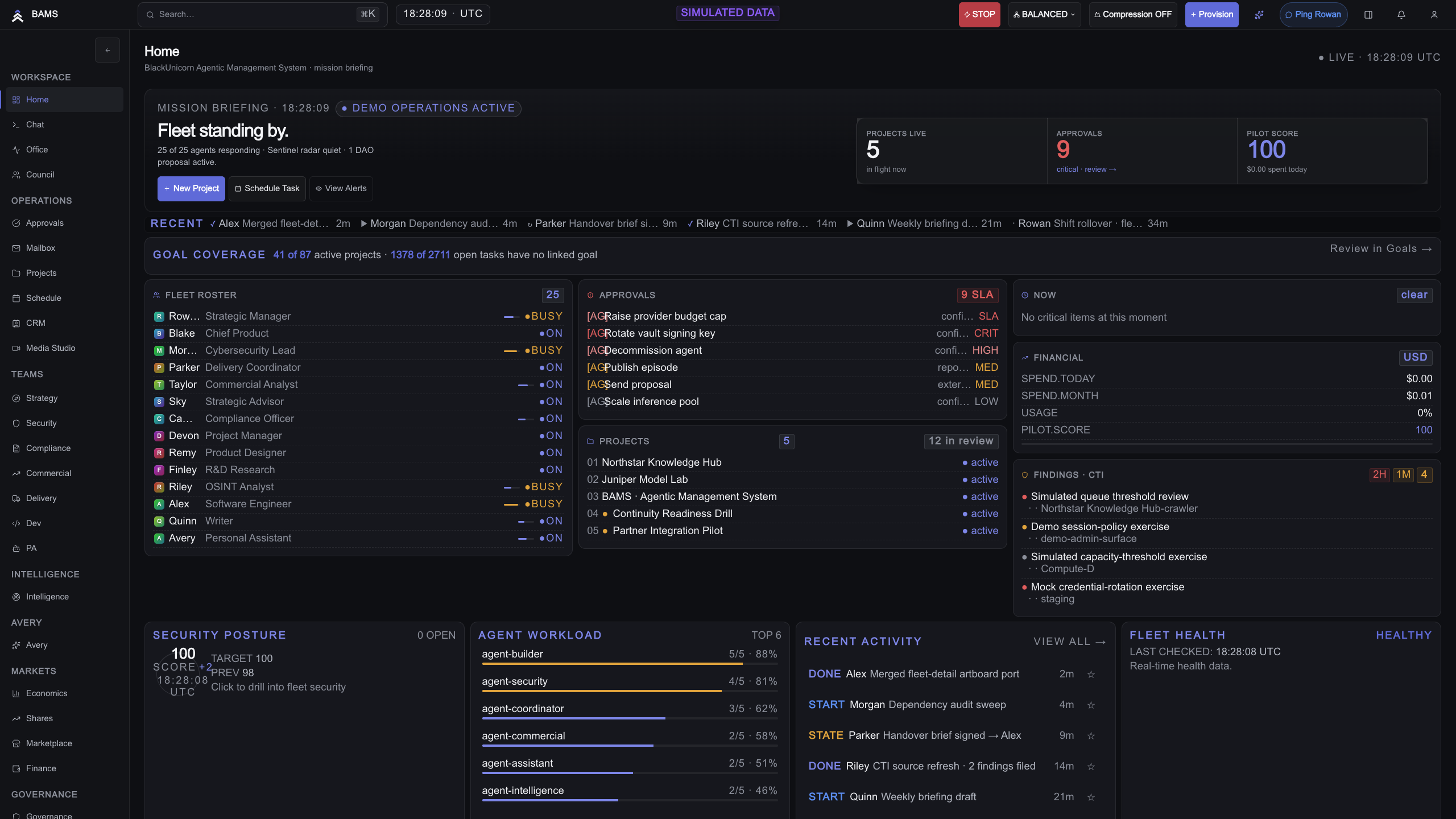
BAMS operating interface. All displayed data is simulated.
A Model Produces Tokens
A model accepts context and produces a response. That capability can be remarkable without being an operating system.
The distinction becomes clear when the response needs to affect real work.
Suppose an agent reviews a supplier contract. The model can identify clauses and suggest a risk summary. The enterprise system has to answer a longer list of questions:
- Which version of the contract is authoritative?
- Is the agent allowed to access that supplier's documents?
- May the text leave the organization's infrastructure?
- Which model route is permitted for this classification?
- Can the agent open a task or only recommend one?
- Which action needs legal approval?
- Where is the decision recorded?
- What happens when the provider is unavailable?
- Can an operator reconstruct the run three months later?
- Can the organization change providers without rebuilding the workflow?
None of these questions is answered by a benchmark score.
They are questions about architecture, authority, and operations.
The Enterprise System Has Seven Jobs
We use seven layers to reason about an operated AI system.
1. Work
The system needs a durable object for the work itself: a project, request, task, case, or incident. That object needs an owner, a state, an acceptance condition, and a history.
Without it, the AI interaction remains a conversation. Conversations are useful. They are poor substitutes for an operating record.
2. Identity
Every agent needs a software identity. The identity determines which tools, projects, memories, budgets, and routes it may use.
Calling the agent an employee does not solve this. It obscures it. The system needs explicit permissions that software can enforce.
3. Context
The system must retrieve approved context from organizational sources and keep access boundaries intact. A relevant document is not automatically an authorized document.
Useful context also needs a lifecycle. Operators need to know who wrote it, where it came from, how long it remains valid, and who may retrieve it.
4. Models
The system should treat a model as a routed resource. Different work may require a local model, a hosted model, a specialised model, or no model call at all.
Operators need health, quota, budget, route, and provider controls. A model choice made in application code is not an operating policy.
5. Authority
An agent can draft, analyse, retrieve, and propose within a defined scope. Actions with financial, legal, security, or external impact may require approval.
The system needs a clear line between a recommendation and an authorized action. That line should be visible to both the agent and the human operator.
6. Evidence
Production work needs a record. The record should connect the request, context, model route, tool activity, approval, result, and exception state.
An application log is not enough. Operators need evidence expressed in the language of the workflow.
7. Control
The organization needs the ability to pause an agent, disable a provider, revoke access, trip a circuit breaker, export required records, and recover the work.
Control is not a page in a policy document. It is an operator action with a recorded result.
What BAMS Puts Around the Model
BAMS implements these concerns as separate operating surfaces rather than hiding them inside a chat window.
The current reference implementation includes project and task surfaces, approval queues, agent identities and lifecycle controls, governed memory, model-provider administration, route bindings, quota and budget views, access controls, governance activity, audit records, and circuit breakers.
The architecture also keeps the main layers separable:
- The operator interface presents work, controls, and evidence.
- The application layer applies workflow and policy.
- The orchestration layer coordinates agent activity.
- The memory layer retrieves and stores governed context.
- The inference layer provides local and external model routes.
- The storage layer keeps operational state and records.
- The security layer handles identity, access, audit, sanitization, and stop controls.
This separation matters because ownership is difficult when every concern is fused into one supplier API.
It also gives an operator a better question than "Which model do we use?"
The question becomes "Which model is allowed for this work, under this policy, with this context, at this cost, and with which fallback?"
That is an operating decision.
A Better Buying Sequence
Organizations often begin with model selection. We recommend reversing the order.
Start with one production workflow. Define the work object, owner, inputs, access boundary, permitted actions, approval points, evidence requirement, failure state, and exit test. Then select model routes that meet those conditions.
The sequence is practical:
- Name the workflow.
- Name the accountable human owner.
- Define the data and access boundary.
- Separate proposals from actions.
- Define the evidence required for acceptance.
- Define stop and recovery procedures.
- Select models and tools for the bounded tasks.
- Test the workflow with operators.
This approach may produce a mixed model layer. A local model can handle sensitive classification. A hosted model can handle a permitted reasoning task. A deterministic service can handle calculation. A human can approve the external action.
That is not architectural untidiness. It is controlled composition.
Ownership Is More Than Hosting
Running a model on infrastructure you control is valuable, but it does not settle ownership of the system.
The organization should also be able to answer:
- Can we inspect and change the routing rules?
- Can we retain our governed context without the supplier account?
- Can we export the evidence needed to operate and audit the workflow?
- Can we revoke an agent's access without asking the supplier?
- Can we replace a provider without rewriting every business step?
- Can our operators run the system from documented procedures?
If the answer to each question depends on a vendor's services team, the infrastructure may be local while the operating dependency remains external.
This is why our deployment position joins the product with a Forward Deployed Engineer. The FDE is not there to become the permanent interpreter of BAMS. The job is to map a bounded workflow, put the controls in place, document the implementation, train the operators, and transfer ownership.
The objective is decreasing dependency on BlackUnicorn.
Where BAMS Stands Today
Precision matters here.
BAMS has a working internal reference implementation with the operating surfaces described above. We are productizing it as a commercial beta appliance for repeatable deployment into client-controlled environments.
That is not the same as claiming a generally available, self-service SaaS product. Customer-safe workspace isolation, connector hardening, packaging, and buyer evidence exports are part of the commercial beta work.
We would rather name that boundary than blur it.
The value of the current system is that the hard operating questions are already represented in the architecture. The work now is to make deployment repeatable without removing the controls that made the reference implementation useful.
The Test
When evaluating an enterprise AI proposal, remove the model name from the slide.
Then ask what remains.
Is there a work model? An identity model? A context boundary? An approval path? An evidence record? A routing policy? A stop procedure? An exit plan? An operator who can run it without the supplier in the room?
If the answer is a chat interface and a promise, the enterprise system has not been designed yet.
A model generates the answer.
The system determines whether the answer can become trusted work.
That is the product boundary BAMS is built to own with the client, then hand over.
The Architecture Review Without a Model Name
A useful review removes provider branding and walks through one piece of work from trigger to evidence.
The reviewer should ask:
How does work enter?
Identify the source event, work object, owner, and acceptance state. If a request begins in chat, show how it becomes durable work.
How is identity established?
Show the human requester, agent identity, service credentials, project access, and tool permissions. Explain how access is revoked.
How is context selected?
Show the authoritative sources, retrieval rule, access check, provenance, and behaviour when sources conflict or disappear.
How is the route selected?
Show the active model route, permitted data class, budget, fallback, and disable procedure. State which parts of the decision are policy and which are implementation.
How does authority change?
Show where an analysis becomes a recommendation and where a recommendation may become an action. Identify the approval owner and rejection state.
What remains after the run?
Show the work result, source reference, route, tool action, approval, exception, and completion evidence in a form the operator can understand.
How does it stop?
Pause the identity or disable the route. Show the effect on queued and in-flight work. Then follow the recovery procedure.
How does the client continue?
Identify the client-owned environment, accounts, configuration, context, documentation, and operator responsibilities required for routine work and exit.
This review exposes the enterprise system without asking the model to impress anyone.
Model Quality Still Matters
Treating the model as a component does not make model evaluation unimportant.
The selected route still needs to meet the workflow's quality, latency, context, tool, availability, and cost requirements. The difference is that evaluation happens inside a defined operating condition.
A model may perform well on a generic reasoning benchmark and fail the workflow's evidence format. Another may produce slightly weaker prose while handling the permitted local route, latency target, and structured output reliably.
The organization can make that tradeoff because the operating system defines what good work means.
This also makes future route changes easier to evaluate. The team can rerun the same acceptance cases rather than beginning with a new collection of demonstrations.
The model remains important.
It simply stops carrying architectural responsibilities that belong elsewhere.
The System Owns the Exception
Normal cases make the model visible. Exceptions make the operating system visible.
A source can be missing, access denied, context contradictory, provider unavailable, budget exhausted, approval rejected, or tool response ambiguous. The model cannot decide the organizational consequence of each condition unless the workflow defines it.
The system needs to preserve the work, assign an owner, expose the reason, and permit only the next actions approved for that state.
BAMS represents work state, approvals, governance activity, agent lifecycle, provider state, and circuit breakers because these exceptions cross product layers. A provider outage is not only an infrastructure event. It affects queued work, routing, budgets, evidence, and operator responsibility.
This is also where client ownership becomes visible. A client operator should be able to inspect the exception, apply the authorized control, and follow the recovery path without waiting for BlackUnicorn to reconstruct the system.
Model evaluation can tell the team how often a bounded reasoning task succeeds. Operating design tells the organization what happens every time it does not.
An enterprise AI system is defined as much by its exception states as by its answers.
<!-- Editorial evidence: E01 in series/bams-no-strings-attached/EVIDENCE-LEDGER.md -->